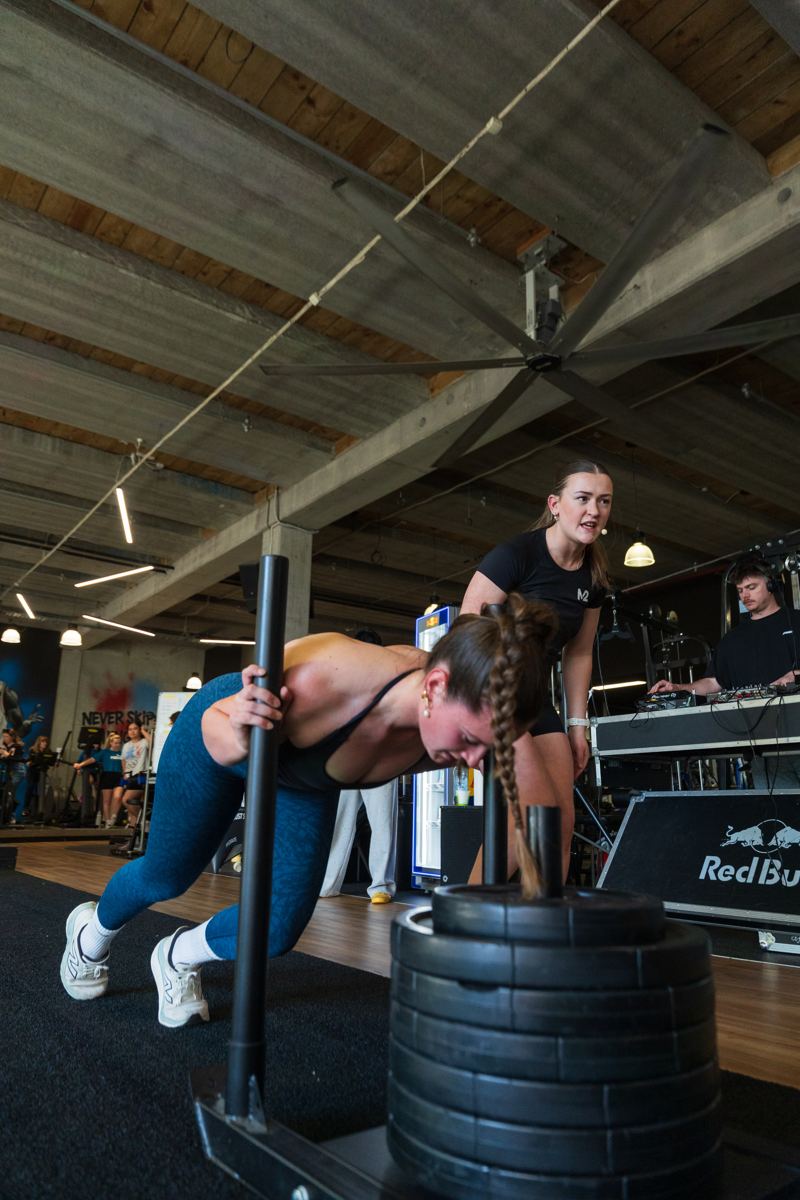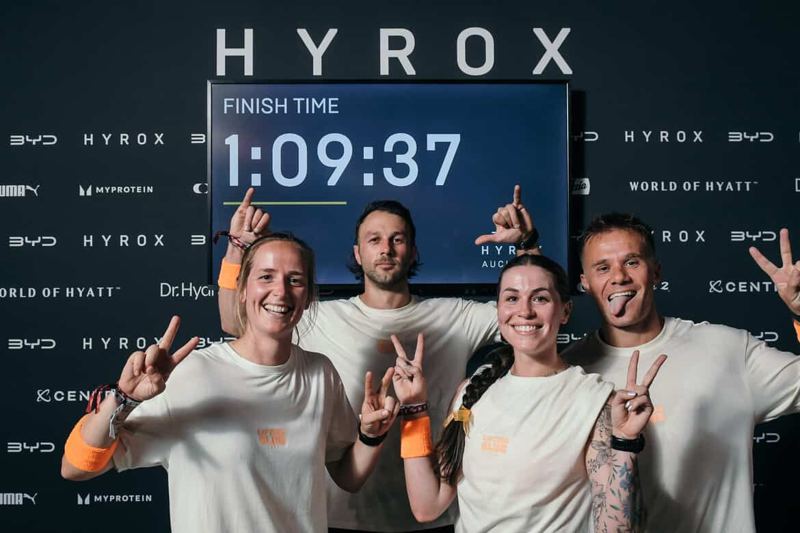
Racing HYROX with other people is a great way to do your first event, or just a fun way to race. You share the work, you've got someone to push you, and there's someone to celebrate with at the end. The team formats have a few rules and tactics of their own, so here's how they work and how to get the most out of them.
The rules below are from the official HYROX Doubles and Relay rulebooks for the 26/27 season. Check the current rulebook before you race, as details can change.
How HYROX Doubles works
Doubles is two people racing as a team. The race is the same eight 1km runs and eight stations, in the same order as a solo race. If you haven't seen the stations yet, read HYROX stations explained.
- You run together. Both partners run every 1km side by side. If one of you runs ahead, it's a penalty.
- You share the stations. You split the work at each station however you like. The full distance or reps still have to be done.
- You enter and leave together. A station can't start until you're both there, and you both leave once it's finished.
- The resting partner stays on their feet. While one works, the other waits nearby, standing, without getting in anyone's way.
There are five Doubles divisions: Women, Men, Mixed, Women Pro and Men Pro. Doubles Mixed uses the same weights as Doubles Men.
How HYROX Relay works
A Relay team is four people. Between you, you cover the whole race, and each person does 2 x 1km runs and 2 stations. Your team decides who does which. One person can do their two runs and two stations back to back, or you can mix it up so people get a rest between turns.
Swaps happen in a transition zone, and at the end all four of you run to the finish together. Relay divisions are Women, Men and Mixed.
How to split the stations in Doubles
The most common way is "you go, I go". One partner works while the other rests, then you swap. On the rower or SkiErg, you might swap every 250m. On wall balls, sets of 10 to 20 reps each work well. On the sleds, many teams swap every length.
A few things to think about:
- Play to your strengths. If one of you is stronger on the sled and the other is better on the rower, split those stations unevenly.
- Don't burn out the stronger partner. You still have to run every 1km together, so keep both of you able to hold the pace.
- Swap often on the hardest stations. Short, fast turns usually beat long, slow ones.
- Agree your plan before race day. Talk through every station so there's no confusion when you're tired.
How to split the Relay
With four people, the aim is to give each person the stations that suit them. A good runner who dislikes heavy work might take the SkiErg and row. Someone strong might take the sled push and sled pull. Think about the order too. If someone takes stations 2 and 3, they'll go back to back with a run in between, which is tough. Spreading your turns out gives everyone more recovery.
Choosing a partner
The best partner isn't always the fittest person you know. For Doubles, the biggest thing is running pace, because you run every 1km together. If one of you is much faster, the faster one will spend the whole race holding back. Pick someone with a similar running pace, then split the stations around your strengths.
Beyond that, choose someone you get on with, who's happy to train together and who wants the same thing from the day. Racing for fun and racing for a time are both great, but it helps if you both agree which one it is.
Training together
Train on your own for most of your fitness, then get together at least once a week. Use that session to:
- Run together at your race pace so you learn what it feels like side by side.
- Practise your station swaps until they are quick and automatic.
- Do a half simulation together a few weeks before race day.
- Learn how your partner talks when they are tired, and agree simple calls like "swap" or "five more".
For the individual side of your training, our free 2 week HYROX plan works for team racers too. And if running is the weak link, running for beginners is a good place to build it up.
On race day
Stick to your plan, but be ready to adjust. If your partner is having a rough patch, take a longer turn on the next station. Talk to each other. Keep the runs steady and don't let the excitement of the start push you too fast. If it's your first race, have a read of your first HYROX too.